Certify every onsite Lenovo technician as match-ready — able to repair and replace devices, follow FIFA processes, and support stadium operations — before their first match.
Lenovo is FIFA's technology partner; an under-prepared technician at any venue risks match-day technology failures — across multiple countries, languages, and time zones, on an immovable deadline.
What it was
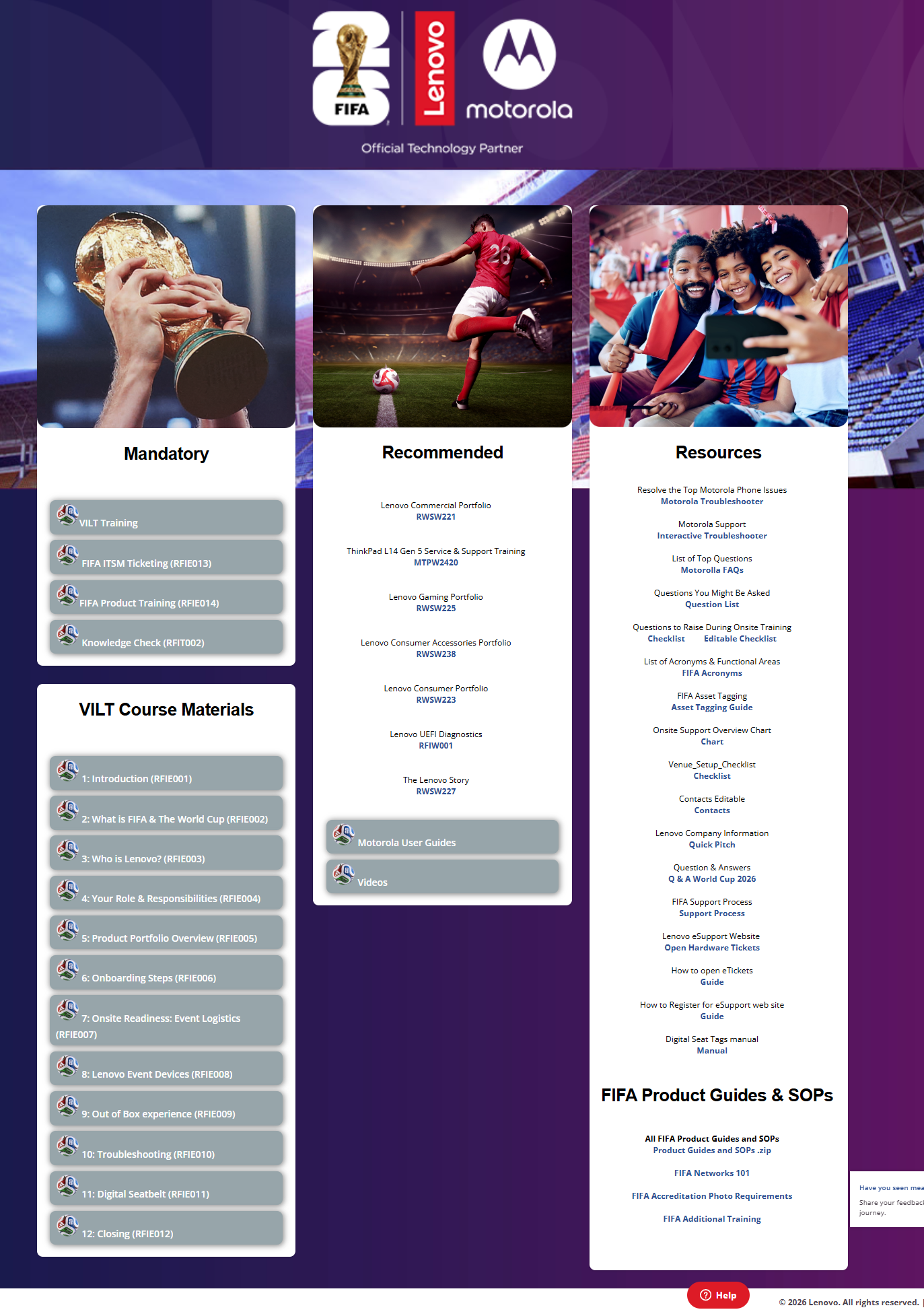
Lenovo is FIFA's official technology partner. For every match, Lenovo on-site technicians are in each stadium keeping the technology running smoothly — which keeps the matches themselves running on time. My program made sure those technicians were ready: trained as Lenovo representatives to repair or replace devices, to support FIFA's processes and procedures, and to know the inner workings of each stadium.
In 2025 the Club World Cup was hosted entirely in the United States. In 2026 the Men's World Cup spanned the USA, Mexico, and Canada — so we trained technicians across all three host countries, plus a contingent who came over from Europe to support. The tournament date never moves, so every piece of training, certification, and access had to land on schedule.
What I owned
Schedule & delivery
As one of two PMs, I owned the training schedule and timeline — keeping our instructional designers on deadline and making sure SME reviews happened when they needed to, against an immovable tournament date.
FIFA SME coordination
Primary point of contact with FIFA subject-matter experts — driving the reviews, resolving questions, and keeping content accurate to FIFA's processes and procedures.
LMS & certification
Set up the LMS and coordinated access for every learner. Each year I made sure a certification exam was built, vetted, and tested on the LMS — and that all technicians could reach both the training and the exam.
Live sessions & communication
Coordinated and ran the live learning sessions — 4 in 2025, 9 in 2026 — fielding questions in chat in real time and keeping communication flowing across a global, cross-functional team.
A playbook, proven then scaled
Year one — building the playbook
Stood up the training program for a US-hosted tournament: built the schedule, coordinated FIFA SME reviews, set up the LMS, and delivered a certification exam plus four live learning sessions that trained 150 technicians — establishing the workflows and stakeholder map the whole program would run on.
Year two — scaling what worked
Scaled the proven playbook to a far bigger event — training technicians across three host countries (USA, Mexico, Canada) plus European support staff. We trained 302 technicians live across nine sessions, with another 52 completing the training asynchronously on the portal, and delivered a second certification exam — all with fewer surprises because year one had already de-risked the approach.
On a famously tight timeline, FIFA wasn't able to complete their portion of the educational outcomes in time. Rather than let it stall the program, I worked directly with them to fold their content into ours — hosting some of their material on our LMS and carving out time in two of our live sessions for FIFA's own people to come in and deliver it. It solved their problem and filled a gap in what our technicians needed to know. A good reminder that program management is as much about partnership as it is about plans.
Owning the full project lifecycle
This wasn't just delivery. I owned the program from planning through formal close-out — and then fed those lessons straight into planning the next cycle.
Led the FUPAN post-project review
Lenovo closes major initiatives with a FUPAN — a structured lessons-learned review. I created the FUPAN, set up the meetings, and gathered and collated feedback across the program's three pillars (live training, online content, and communication), framed as Stop / Start / Keep / Modify. Complete for 2025; I run the 2026 review in August.
Authored the 2026 training proposal
Turned those lessons into a plan for the bigger event: defining scope and guiding principles, a collaborative delivery model with clear content ownership, a resourcing plan, a wave-based training timeline, and an honest benefit-and-risk analysis — with scope-creep and change control built in from the start.
Methods & tools
The approach that kept an immovable deadline on track:
Formalizing the practice
Programs like this are why I'm pursuing my PMP certification — putting a formal framework around years of hands-on program and project leadership. In progress, expected 2026.
Leadership is where I'm headed
Instructional design taught me how people learn; program management taught me how to deliver at scale. I bring both to leadership roles.