AI-Powered Support Simulation
A conversational training platform where learners troubleshoot with an AI that role-plays the customer — and coaches them afterward. Built with Articulate Storyline and Microsoft Copilot Studio.
Give support technicians realistic, repeatable practice at live troubleshooting conversations — so they build judgment, not just recall — and coach them on each attempt.
Traditional support training — static content, linear simulations, knowledge checks — left learners under-prepared for the messy, branching reality of real calls. The team needed conversational practice it could build and scale without one-off scripting.
A short walkthrough of a learner working through an AI-driven troubleshooting call.
Text description of this video
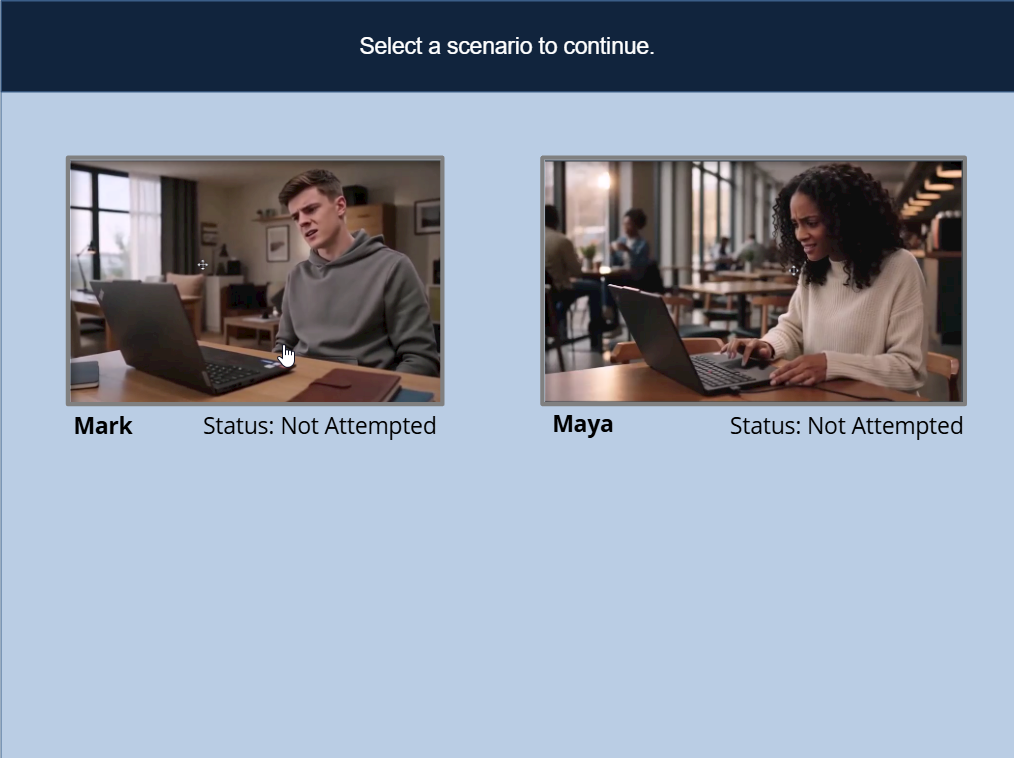
- The simulation opens on a start screen where the learner selects a troubleshooting scenario.
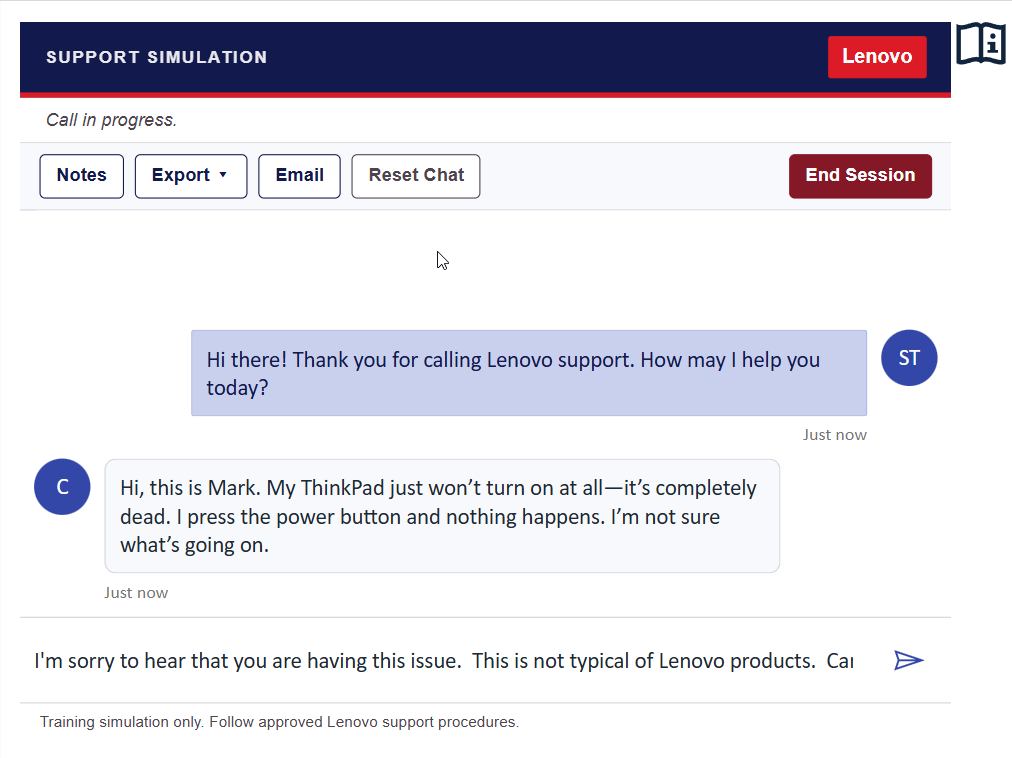
- A simulated customer — played by an AI agent — opens the conversation by describing a support problem.
- The learner responds in their own words; the AI customer answers in character, adapting to each decision rather than following a fixed script.
- The learner works the call like a real one, asking questions and moving through the troubleshooting steps to diagnose and resolve the issue.
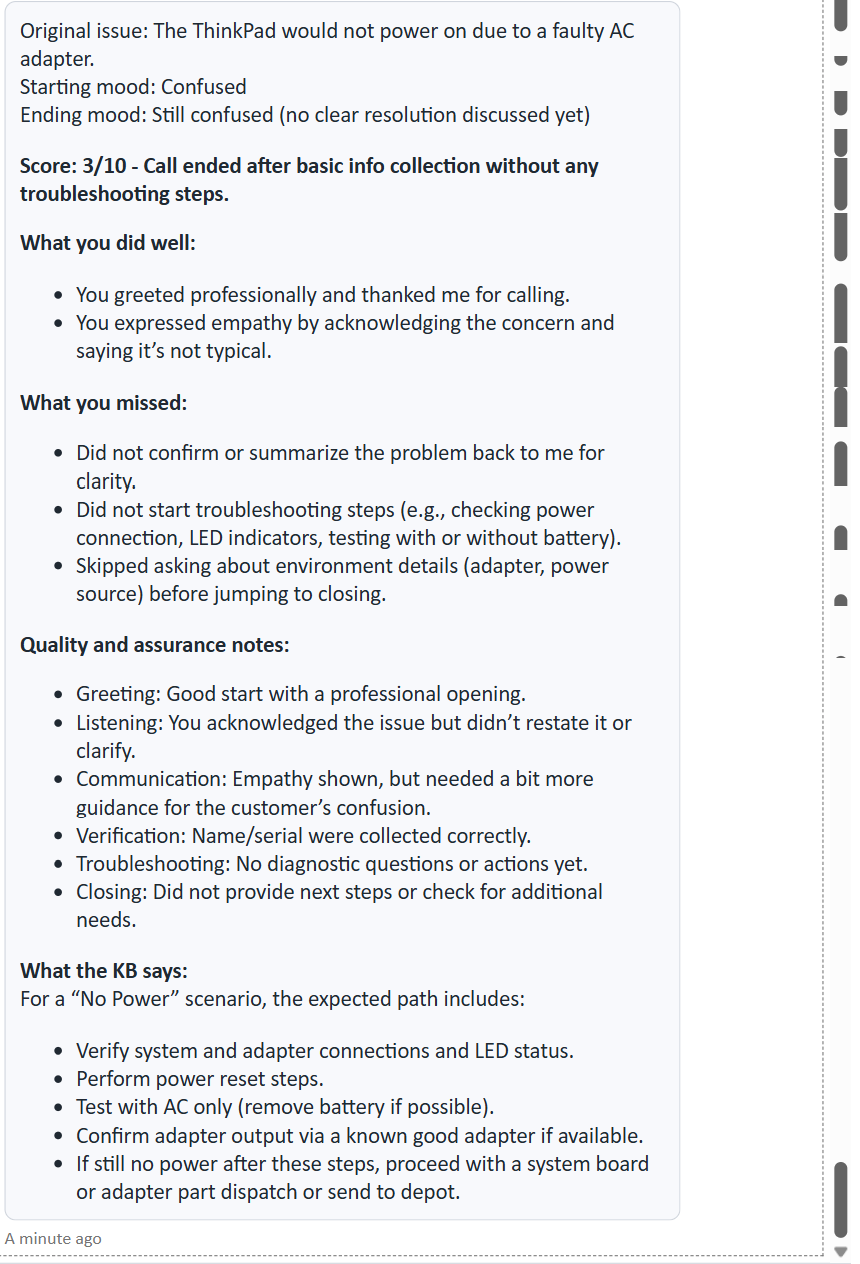
- At the end, the simulation delivers AI-generated coaching — a performance summary, what was handled well, and any troubleshooting steps that were missed.
Practice that talks back
Most support training relies on static content, linear simulations and knowledge checks. Learners rarely get to practice the actual conversation — the messy, branching, real-time troubleshooting that the job is really made of.
This platform replaces scripted branching with a live AI agent that plays the customer. Learners type or speak their way through a support call, the AI responds in character based on their decisions, and the session ends with AI-generated coaching on what they did well and what they missed.
Three layers working together
The wrapper the learner moves through.
- Scenario selection
- Learner navigation
- Progress tracking
- Completion management
- LMS integration
The customer the learner talks to.
- Role-plays customers
- Responds dynamically to learner actions
- Follows troubleshooting workflows
- Evaluates learner performance
- Provides coaching feedback
The coach at the end.
- Performance scores
- Coaching recommendations
- Missed troubleshooting steps
- Knowledge-based feedback
- End-of-session debriefs
A look at the platform
A few views of the scenario selection, the live conversation, and the AI coaching debrief.
AI-generated intro videos
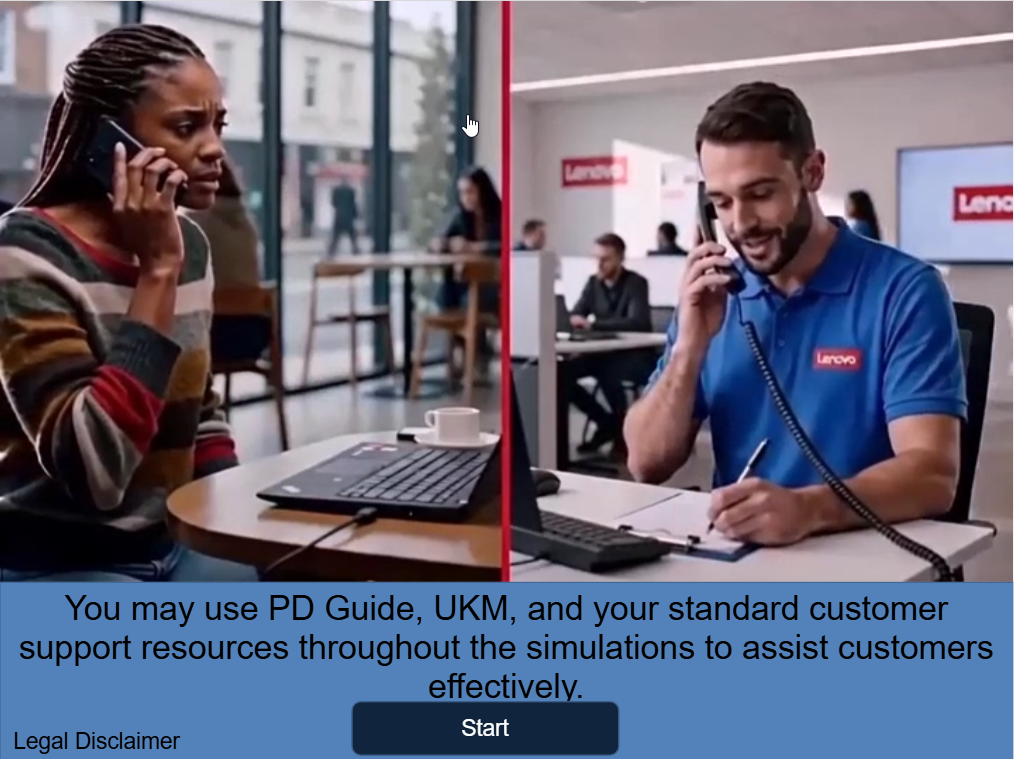
Each scenario opens with a short video that sets the scene — a frustrated customer about to call support. I produced these with Magnific, generating several clips using the same characters for continuity, then stitched them together in Camtasia.
In Camtasia I also reversed some clips to create a seamless looping effect, so each scenario intro feels alive rather than a static frame. These play right before the learner starts the call.
From scripted branches to real conversations
- Pre-written branching paths
- Learner picks from set options
- Same experience every attempt
- Feedback fixed in advance
- Open, adaptive conversation
- Learner responds in their own words
- The scenario shifts with their choices
- Personalized AI coaching every run
Owned in-house, and built to scale
No third-party simulation vendor, no per-seat licensing. The entire solution runs on infrastructure we already own:
- ✓ Our own LMS
- ✓ Our own Microsoft Copilot instance
- ✓ Our own Storyline / SCORM file
Building it ourselves instead of buying a platform is a cost saving worth real consideration.
We launched with two scenarios and are building toward five — and there's no ceiling. Each new scenario takes only:
- • Minimal updates to the Copilot agent
- • Minimal updates to the Storyline file
- • Zero changes to the webserver files
A reusable foundation, not a one-off
The simulation work drew leadership interest as a practical enterprise application of generative AI — one that goes beyond productivity gains to improve learning effectiveness, increase realism and scale coaching that previously required a live facilitator.
Rather than solving a single training problem, the architecture became a reusable framework — adaptable to customer service, sales conversations, leadership development, soft-skills practice and coaching simulations.
This grew out of a broader AI initiative
The simulation is the flagship of the AI-enablement work I've led across our learning team — workflows, training and governance.